Skills vs. Agents
In Claude Code, the terms “skill” and “agent” often lead to confusion. Skills are designed to execute specific tasks, while agents embody underlying thinking models and working patterns. Understanding these differences is crucial for building an efficient AI collaboration workspace.

When I first introduced skills and agents on Claude Code, many users asked about their differences and whether prompts should be placed in skills or created as agents. Initially, I took a straightforward approach. The most notable feature of an agent in Claude Code is its ability to operate independently, without disrupting the current conversation or consuming context resources, and it can be linked to a specified model. Thus, I created prompts for tasks like document review as agents.
However, as I delved deeper into using Claude Code and its upgrades, I realized that this approach was not optimal for several reasons:
- This method essentially still involves creating skills, and dispersing specific capabilities between skills and agents can lead to fragmented and chaotic prompt management, making future maintenance cumbersome.
- If the sole purpose is to operate independently, it is unnecessary since Claude Code now supports enabling agent operation for skills or allowing agents to actively mount certain skills during operation, effectively addressing previous scenario requirements.
Fundamental Differences Between Agents and Skills
I have written extensively about skills, and many experts have shared insights online, so most users are likely familiar with them. Simply put, a skill is a prompt fragment used to execute specific processes or solve particular problems (which can also include scripts).
So, what is an agent primarily used for? When in doubt, the official documentation serves as the best guide. We can glean insights from several built-in agents in Claude Code, including:



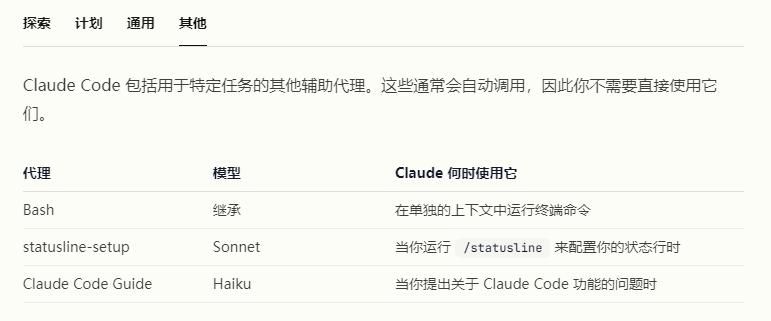
Excluding a few in the “Others” category, the Explore, Plan, and General-purpose agents have distinct characteristics. They are designed for broader scenarios and are supported by a unified mechanism to ensure quality generation.
For a clearer understanding, the Planning mode on Antigravity is quite similar to these agents in Claude Code. In Planning mode, the AI conducts in-depth analysis and planning of tasks and execution steps, then follows the plan to provide users with feedback on changes, completing the process through Task → Implementation → (user-requested) content generation → Walkthrough. This mechanism enables high-quality delivery.
Thus, it is evident that agents do not carry specific execution techniques or tricks; instead, they represent deeper thinking models and working patterns. This is the fundamental distinction between agents and skills.
Designing Agents
Agents are not aimed at a specific problem but rather at a category of problems, providing process management for solving these types of issues.
In our work scenarios, this processing method is quite common, such as the PDCA model in quality management, the pyramid model in document writing, and the snowflake writing method in story creation. The generation-review cycle I previously exemplified, along with the popular multi-expert review model, can also be solidified into a framework for problem-solving.
Why are these frameworks effective? Because they establish a systematic approach to tasks, clarifying processes, rules, and standards. This avoids aimless attempts and prevents arbitrary actions that could compromise delivery quality. With these methods, even novices can achieve satisfactory results.
In the context of human-machine collaboration, transforming these frameworks into prompts results in agents. Calling an agent essentially means selecting a thinking model or framework to enhance output quality.
Now, is the design of agents clearer?
The writing techniques remain the same, focusing on defining roles, workflows, and read-write interactions. Agents emphasize ensuring result quality through effective process control rather than fixating on minor detail techniques.
Conclusion
The above reflects my understanding of the mechanisms of skills and agents in Claude Code after a period of practice.
As Claude Code continues to evolve, both skills and agents are becoming more refined. While flexibly building an AI writing workspace, we can implement more detailed control and configuration, and the usage scenarios for both are becoming increasingly clear.
Currently, the built-in agents in Claude Code do not fully align with the scenarios of online literature creation. Issues such as improving plot quality, addressing memory problems, and avoiding out-of-character (OOC) moments are challenges that writing agents must tackle.
Interested individuals can brainstorm and experiment, and perhaps create something extraordinary!
For more information on building agents in Claude Code, refer to the official documentation at: https://code.claude.com/docs/zh-CN/sub-agents
Comments
Discussion is powered by Giscus (GitHub Discussions). Add
repo,repoID,category, andcategoryIDunder[params.comments.giscus]inhugo.tomlusing the values from the Giscus setup tool.