Vibe Coding’s Impact on Open Source
Is vibe coding threatening the open source ecosystem? Recently, several prominent researchers pointed out in a preprint paper that observed trends and some modeling results suggest this might indeed be the case. Their warnings focus on two main aspects: user interaction is gradually being stripped from open source projects, and the difficulty of starting new open source projects has significantly increased.
Even popular open source projects are seeing a decline in website traffic as the demand for code downloads and documentation is replaced by interactions with large language model chatbots. This decline also reduces the potential for commercial planning, sponsorship fundraising, and community forum operations. The sharp decrease in usage of community forums like Stack Overflow reflects this trend.
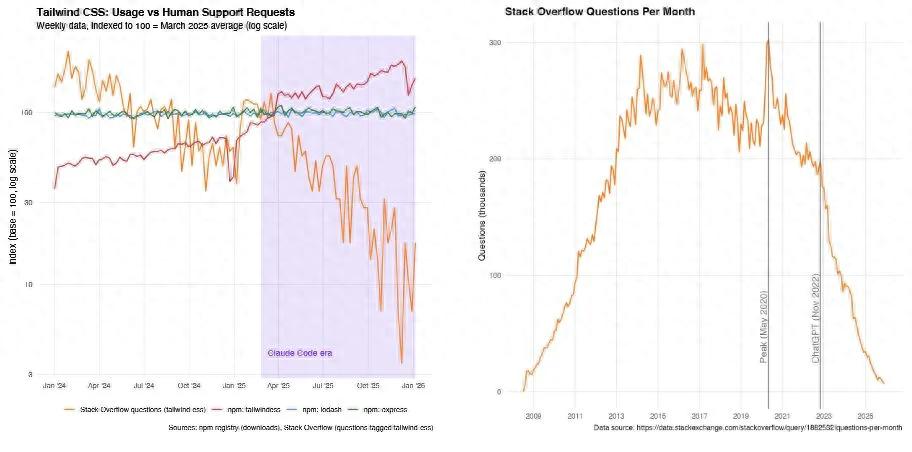
The researchers concluded that under the widespread application of vibe coding, significant reforms in the compensation model for maintainers are necessary to sustain the current scale of open source software.
AI Revolution or Pressure Test for Human Intelligence
If the effect of “AI-assisted” software development is understood as delegating actual engineering and development work to the statistical models of large language models, the problem becomes evident. The vibe coding model discards the natural selection mechanism for libraries and tools within the open source community. It is almost certain that the statistical models of large language models will only select the most prevalent technical dependencies from their training datasets when generating output content. Moreover, large language models do not interact with library or tool developers, do not submit usable bug reports, and are unaware of any potential issues, regardless of how well-documented those issues are.
Since Microsoft launched GitHub Copilot in 2021, this has been a highly controversial topic. Research reports in 2024 indicated that using Copilot and similar chatbots for vibe coding did not yield any real benefits, unless an increase of 41% in bugs was considered a success metric. By 2025, negative sentiments intensified, with large language model chatbots widely criticized for diminishing users’ cognitive abilities, and vibe coding reportedly reducing development efficiency by 19%. Even seasoned developers who tried these tools expressed strong disapproval in their reviews.
Currently, the software development field is already showing many negative impacts from “AI garbage.” Daniel Stenberg, the author of the cURL project, has repeatedly complained that the quality of submitted bug reports has declined due to “AI garbage” caused by large language models. As a result, the project decided to suspend its bug bounty program starting February 1, 2026. Some users pointed out that “the least reliable aspect of AI lies in simple repetitive tasks, as it often makes random errors. The more demands placed on it, the more prone it is to mistakes, leading you to check the entire program line by line to ensure it performs as required. The worst practice when using large language models is to ask it to ‘clean up this code without changing any functionality or logic’; it will absolutely do the opposite.”
All these phenomena seem to reinforce the view that the “AI revolution” may be more of a pressure test for human intelligence rather than a genuine enhancement of development efficiency or code quality.
It remains unclear how significant the impact of vibe coding will be, but software ecosystems related to JavaScript, Python, and various web technologies are likely to be the first to feel the effects, as their user base appears more receptive to this development model, and the related technologies constitute the largest share in the training datasets of large language models.
Diminished Benefits for Open Source Maintainers
Moreover, under the compensation mechanisms related to vibe coding, the vast majority of open source projects struggle to benefit.
The paper points out that vibe coding reduces software production costs but also alters the way users interact with the software ecosystem. In the traditional open source software business model, developers would select software packages, read documentation, and communicate with maintainers and other users. However, in the vibe coding model, AI agents can end-to-end select, combine, and modify software packages, leaving human developers potentially unaware of which upstream components were used.
This shift raises a balance issue regarding the sustainability of open source software: once the mechanisms for developer engagement and selection are adjusted, will the productivity gains from vibe coding be sufficient to offset the loss of demand for open source software?
As a non-competitive factor in producing more software, the social value generated by open source software far exceeds its direct production costs. Many projects rely on direct user attention and participation to maintain operations, such as documentation access, bug reports, public Q&A, and reputation (downloads, stars, citations), with individual maintainers and small teams primarily obtaining private returns through this (higher visibility can lead to paid opportunities or other forms of recognition).
However, in the long-term equilibrium, when AI replaces direct interaction, this technology that makes software easier to use may simultaneously erode the funding supply and development motivation based on user participation. “The broader adoption of vibe coding will reduce the entry and sharing of new open source projects, lowering the availability and quality of open source software; despite productivity improvements, overall welfare will decline.”
Although the paper suggests that when the code of open source projects is used by large language models, OpenAI or Google could provide small funding subsidies to these projects, this idea bears an unfortunate resemblance to Spotify’s business model, where about 80% of creators’ works receive very low play counts, essentially earning nothing.
The paper concludes that vibe coding represents a fundamental shift in the way software is produced and consumed. While the productivity gains are real and significant, the threats it poses to the open source ecosystem that underpins modern software infrastructure are equally present. The solution is not to slow down the adoption of AI but to redesign business models and systems to return value to open source software maintainers.
Developers Divided: The Early End of Commercial Software?
Meanwhile, there are some positive feedbacks about vibe coding within the community.
“AI helped me complete my first open source project,” one developer stated. “I have been a programmer for over 30 years, mastering several popular and outdated programming languages, but I always felt it was not worth it to develop a complete application from scratch, and my areas of expertise did not help. Now, I can really create a complete application from start to finish, including testing and all aspects. I know what an application should look like and how it should function, and I understand design; now I am the boss and the demand side, while AI just does what I ask.”
He also pointed out that in his primary development work, AI handles bug reports much faster than he could. “I give it some hints, like ’the issue might be in this handler or this js file, here’s a screenshot, you can log in with Chrome MCP and then execute a, b, and c.’ So far, I have resolved about 30 bugs reported by others using this method.”
Another developer mentioned, “I use AI to filter available information while coding, saving me the trouble of sifting through dozens or hundreds of related questions on Stack Overflow and other sites to find suitable solutions. So the usage of such platforms may have decreased, but a significant part of the reason is that everyone is leveraging AI to sift through massive data and quickly find useful answers. I personally experienced that AI helped me a lot in this regard.” However, he also noted, “If I let AI write code for me, I still need to modify and adapt that code afterward, and I won’t allow it to use any code indiscriminately. We, as users, must be responsible for the products we deploy. If developers rely entirely on AI, we face the risk of system failures, and users will just be left asking that silly little white box in the corner for fault reasons, having long forgotten how to debug.”
In response, some netizens argued that the issue is not whether AI is useful or can help people, but whether it will endanger the development of open source software. “Open source software is becoming harder to accept widely, as some users no longer participate in bug checking; even if they find bugs and provide feedback, it is often irrelevant information. Moreover, large language models may be more inclined to copy an open source project and make slight modifications rather than introduce usage through formal channels. There are many such issues, and the imbalance between effective and ineffective information in the open source field is more severe than ever.”
However, some netizens believe that vibe coding will not threaten open source software at all, and that the end of commercial software will come sooner. “Existing open source projects are maintained by professional developers, and professional developers with LLMs are more efficient, producing code of much higher quality than non-programmers using LLMs. The development speed of open source software will far exceed the past and eventually mature, even surpassing commercial software in terms of functionality and stability, rather than being filled with a lot of redundant and low-quality code like commercial software.”
“Open source software will only increase, as more people will create tools, and since writing these tools does not take hundreds of hours, they will be more willing to share. Updating and creating open source code will become easier. If I were a for-profit software company, I would be worried.” Many others echoed this sentiment.
Subsequently, some raised the concern that developers with poor skills would add extra burdens to the “gatekeepers” of open source projects, needing to directly ban those who submit low-quality AI-generated code. One violation would lead to immediate expulsion.
Comments
Discussion is powered by Giscus (GitHub Discussions). Add
repo,repoID,category, andcategoryIDunder[params.comments.giscus]inhugo.tomlusing the values from the Giscus setup tool.